
Now that the worst of the summer heat is behind us, we have been getting the same question a lot: "Can you just buff out these scratches?" It is a fair question, and the answer depends on what those scratches actually are. So we wanted to break down what paint correction really is, how to tell if your vehicle needs it, and what the difference is between our two levels of service.
Swirl Marks Are Not Dirt
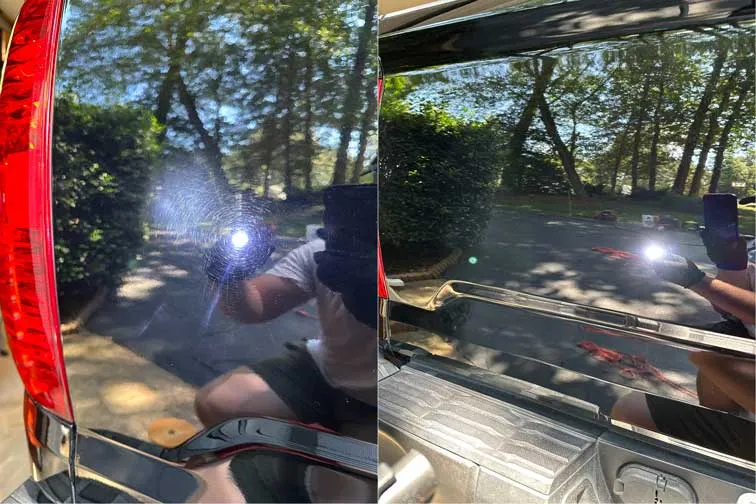
If you have ever pulled into a parking lot on a sunny day and noticed what looks like a spiderweb pattern across your hood, those are swirl marks. They are not dirt, and no amount of washing will remove them.
Swirl marks are thousands of very fine scratches in your clear coat. Most of them come from washing, not from driving. Automatic car washes with spinning brushes are the biggest culprit, followed by dirty wash mitts, gritty drying towels, and wiping dust off a dry vehicle. Every one of those drags small particles across the paint and leaves a mark.
Here is the important part: wax and sealants do not remove swirls. They temporarily fill them in and hide them, which is why a car can look great leaving the shop and dull again a month later. Paint correction is different. It actually levels the clear coat to remove the defect instead of masking it.
How to Tell If You Need It
The easiest test costs nothing. Pull your vehicle into direct sunlight, then look across the hood at an angle rather than straight down.
- Spiderweb pattern that seems to radiate from a center point as you move — those are swirls, and correction will remove them.
- Flat, hazy finish even when the car is clean — that is oxidation, and correction will bring the gloss back.
- Deep scratches you can catch with a fingernail — those are through the clear coat. Correction can improve how they look, but it will not make them disappear.
Darker colors show all of this far more than lighter ones. A black vehicle and a silver vehicle can have the exact same defects, and you will only notice them on the black one.
1-Step or 2-Step?
Our 1-Step Paint Correction starts at $600. We do a single polishing stage that removes minor scratches, swirl marks, and oxidation, and gets the paint to roughly 60–80% clarity. For most daily drivers, this is the right call and the results are dramatic.
Our 2-Step Paint Correction starts at $1,200. It includes everything in the 1-Step, plus an additional refining polish that brings the paint to 80–90% clarity. This is the one to choose for darker colors, show vehicles, or anyone who wants the deepest possible finish.
One thing worth knowing: correction works by removing a very small amount of clear coat. Your vehicle has a finite amount, so this is not something to do every year. The goal is to correct the paint once, then protect it properly so it stays that way.
Correct First, Then Protect
This is the part people most often get backwards. Applying a ceramic coating over uncorrected paint seals the swirl marks underneath it, and now they are locked in for the life of the coating.
The right order is always correction first, protection second. Once the paint is corrected, our 2 Year Ceramic Coating ($250) or 5 Year Ceramic Coating ($450) keeps it looking that way and makes future washes far easier and safer.
A Recent Example
We recently did paint correction on a Porsche Cayenne GTS at the client's home. Being fully mobile means we come to your driveway, so there is no dropping the vehicle off and no waiting around. The owner got progress photos throughout the process, which is standard for us on bigger jobs like this one.
As always, if you are not sure which service your vehicle needs, just reach out. We are happy to take a look and give you an honest recommendation, even if the answer is that you do not need correction at all.